+32 460 23 96 44

On this page
- The Reality of Jewelry Ecommerce
- The 5 Biggest Reasons Jewelry Websites Fail
- 1. Poor Product Visualization
- 2. Inconsistent Product Photography
- 3. Limited Product Angles
- 4. Slow Product Launch Cycles
- 5. High Photography Costs
- Why Product Visualization Determines Online Jewelry Sales
- The Rise of 3D Jewelry Rendering
- How 3D Rendering Solves Jewelry Ecommerce Problems
- Perfect Visual Consistency
- Unlimited Product Variations
- 360 Degree Product Visualization
- Faster Product Launches
- Case Study: Digital Transformation in Jewelry Retail
- The Future of Jewelry Ecommerce
- Conclusion
Over the last decade, the jewelry industry has experienced a massive digital shift.
Customers no longer visit stores first. Instead, they discover jewelry through:
Google searches
social media platforms
online jewelry stores
digital catalogs
This shift has pushed thousands of jewelry brands to launch their own websites.
But here’s the uncomfortable truth.
Most jewelry websites fail.
Despite beautiful layouts and expensive development, many jewelry brands struggle to convert website visitors into buyers.
Traffic comes in… but sales remain low.
The reason is rarely the product itself.
In most cases, the problem lies in how jewelry is presented online.
Unlike clothing or electronics, jewelry relies heavily on visual perception. The sparkle of a diamond, the reflection of gold, and the brilliance of gemstones all play a major role in purchase decisions.
When jewelry visuals fail to capture these details, customers hesitate.
In this article, we will explore why the majority of jewelry websites struggle to convert visitors and how advanced 3D jewelry rendering technology is helping brands overcome these challenges.
The Reality of Jewelry Ecommerce
Selling jewelry online is significantly more challenging than selling most other products.
Jewelry is:
high value
emotionally driven
visually dependent
Customers want to examine every detail before making a purchase.
In a physical jewelry store, this experience happens naturally.
A customer can hold the ring, rotate it, observe the sparkle of the diamond, and feel the craftsmanship.
Online stores must recreate this experience digitally.
And this is where most jewelry websites fail.
Read More: Amazing Benefits of 3D Rendering in Jewelry Marketing
Read More: What are some tips for creating stunning 3D jewelry renderings?
Read More: How to Create 3D Models for Jewelry Design: Best Practices
Read More: Top Techniques for High-Quality Jewelry Renderings
Read More: Customizing Jewelry with 3D Technology: A Game-Changer for Your Brand
The 5 Biggest Reasons Jewelry Websites Fail
1. Poor Product Visualization
Jewelry is one of the most visually demanding products in ecommerce.
Unfortunately, many jewelry websites rely on low-quality product photography.
Common problems include:
dull diamonds
flat gemstones
poor lighting
unrealistic reflections
These visual flaws reduce perceived product value.
When jewelry appears less brilliant online, customers subconsciously assume the product is lower quality.
Even if the jewelry itself is exceptional.
2. Inconsistent Product Photography
Jewelry brands often photograph products in multiple shoots over time.
This leads to inconsistencies such as:
different lighting setups
varying background colors
inconsistent reflections
Luxury brands rely heavily on visual consistency.
When product images vary across collections, the website begins to feel less premium.
Consistency is critical for building trust.
3. Limited Product Angles
Many jewelry websites display only a few images for each product.
Typically:
front view
side view
However, jewelry buyers want to examine fine details like:
diamond settings
prong structure
band thickness
gemstone clarity
Without detailed visuals, customers hesitate to purchase.
4. Slow Product Launch Cycles
Traditional jewelry photography requires the physical product to exist before images can be captured.
This creates delays in:
marketing campaigns
website launches
new collection releases
In fast-moving ecommerce environments, slow product launches create a competitive disadvantage.
5. High Photography Costs
Professional jewelry photography is expensive.
Costs include:
studio rental
lighting equipment
macro lenses
professional photographers
image retouching
For brands with large product catalogs, photography costs can become overwhelming.
And every new product variation requires another shoot.
Why Product Visualization Determines Online Jewelry Sales
Research in ecommerce consistently shows that product visuals are the most important factor influencing purchase decisions.
Customers cannot physically examine jewelry online.
Instead, they rely entirely on visual cues to evaluate quality.
This includes:
gemstone brilliance
metal reflection
craftsmanship details
If visuals fail to communicate luxury and precision, conversion rates drop dramatically.
The Rise of 3D Jewelry Rendering
To solve these challenges, many jewelry brands are adopting 3D jewelry rendering.
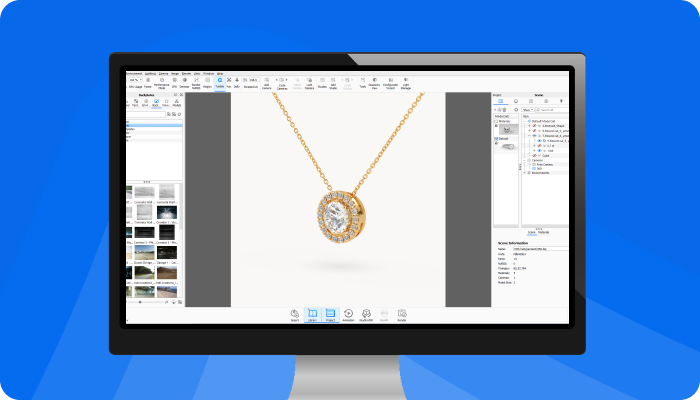
3D rendering transforms digital jewelry designs into photorealistic images that simulate real-world materials, lighting, and reflections.
Unlike traditional photography, rendering does not require a physical product.
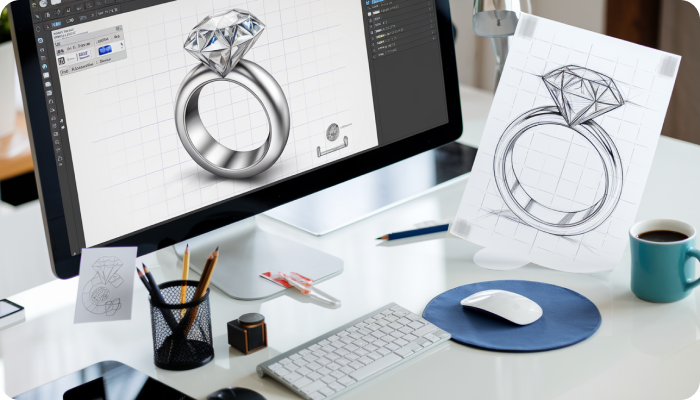
Instead, images are generated from digital CAD models.
This technology allows jewelry brands to create highly detailed visuals with complete control over lighting, materials, and angles.
How 3D Rendering Solves Jewelry Ecommerce Problems
Perfect Visual Consistency
Rendering ensures every product is displayed under identical lighting conditions.
This creates a consistent luxury appearance across the entire catalog.
Consistency strengthens brand perception and trust.
Unlimited Product Variations
Jewelry products often exist in multiple variations.
Examples include:
yellow gold
white gold
rose gold
platinum
With traditional photography, each variation requires a new photoshoot.
With rendering, variations can be generated instantly from a single 3D model.
360 Degree Product Visualization
Rendering enables interactive product views.
Customers can rotate jewelry pieces and examine them from every angle.
This level of detail replicates the in-store viewing experience.
Faster Product Launches
Jewelry brands can render products directly from CAD designs before manufacturing begins.
This allows companies to:
Launch marketing campaigns earlier
publish product pages faster
showcase new collections instantly
Speed to market becomes a major advantage.
Case Study: Digital Transformation in Jewelry Retail
A mid-sized jewelry retailer recently transitioned from traditional photography to digital rendering.
Previously, the brand struggled with:
inconsistent product images
long photography timelines
high production costs
After implementing rendering for product visuals, the company experienced several improvements.
Product launches became significantly faster.
Visual consistency improved across the entire catalog.
Customers engaged more with product pages due to enhanced visuals and interactive viewing options.
The result was a noticeable improvement in online conversion rates.
The Future of Jewelry Ecommerce
The role of digital visualization in jewelry retail is expected to grow rapidly.
Future innovations include:
real-time 3D ring customization tools
augmented reality jewelry try-on experiences
interactive product configurators
These technologies will allow customers to design and preview jewelry in ways that were previously impossible.
At the core of these innovations lies high-quality rendering technology.
Conclusion
The jewelry industry is undergoing a major digital transformation.
As more consumers purchase luxury products online, the importance of visual presentation continues to increase.
Many jewelry websites fail not because of poor products or weak marketing, but because their product visuals fail to capture the beauty and brilliance of the jewelry itself.
Advanced rendering technology offers a powerful solution.
By creating photorealistic visuals, enabling customization, and accelerating product launches, 3D rendering is helping jewelry brands build stronger ecommerce experiences and improve online sales.
For jewelers seeking to compete in the digital marketplace, investing in better product visualization may be one of the most important decisions they make.
For jewelry brands looking to upgrade their product visuals and improve online conversions, professional rendering services can provide a significant advantage.
Explore advanced jewelry visualization solutions with JewelExperts and discover how photorealistic rendering can transform the way customers experience your jewelry online.