+32 460 23 96 44

On this page
- What Is 3D Jewelry Rendering?
- 1. Jewelry CAD Modeling
- 2. Material Simulation
- 3. Gemstone Physics
- 4. Lighting & Environment
- 5. Final Photorealistic Render
- The Problem With Traditional Jewelry Photography
- High Production Costs
- Limited Flexibility
- Product Availability Issues
- Why 3D Jewelry Rendering Is Transforming the Industry
- 1. Unlimited Product Variations
- 2. Faster Product Launches
- 3. Perfect Visual Consistency
- 4. Better Customization Experiences
- 5. Higher Conversion Rates
- The Technology Behind Photorealistic Jewelry Rendering
- Physically Based Rendering (PBR)
- Ray Tracing
- HDRI Lighting
- The Role of Rendering in Jewelry E-commerce
- The Rise of Digital Jewelry Marketing
- Future Trends in Jewelry Visualization
- Real-Time 3D Product Configurators
- Augmented Reality Jewelry Try-On
- AI-Driven Jewelry Design
- Virtual Jewelry Showrooms
- The New Standard for Jewelry Visualization
The Digital Transformation of the Jewelry Industry
For decades, jewelry brands relied on traditional product photography to showcase their collections. Diamond rings, gold necklaces, and gemstone earrings were photographed under carefully controlled lighting setups in expensive studios.
But the digital era has changed everything.
Today, consumers discover jewelry through Instagram, e-commerce websites, digital catalogs, and online marketplaces. This shift has created a new challenge for jewelry brands:
How do you present jewelry online with maximum visual impact while maintaining cost efficiency and scalability?
The answer increasingly lies in 3D jewelry rendering.
Leading jewelry companies are now replacing traditional photography with photorealistic 3D rendering because it offers unmatched flexibility, scalability, and visual precision.
In this article, we will explore:
Why 3D jewelry rendering is disrupting traditional jewelry photography
The technology behind photorealistic rendering
How jewelry brands increase conversions using rendering
Why digital product visualization is becoming the new industry standard
Read This: Amazing Benefits of 3D Rendering in Jewelry Marketing
What Is 3D Jewelry Rendering?
3D jewelry rendering is the process of transforming a CAD (Computer-Aided Design) model of jewelry into a highly realistic image using advanced rendering software.
The process typically involves several stages:
1. Jewelry CAD Modeling
Designers create a digital 3D model of the jewelry piece.
2. Material Simulation
Precious metals like gold, platinum, and silver are simulated with accurate reflective properties.
3. Gemstone Physics
Diamonds and gemstones are rendered using advanced light refraction algorithms.
4. Lighting & Environment
Studio lighting is digitally recreated to achieve realistic reflections and sparkle.
5. Final Photorealistic Render
The final image looks nearly identical to a professionally photographed product.
Modern rendering engines simulate complex optical effects such as:
diamond dispersion
gemstone refraction
metal reflections
microscopic surface textures
The result is a hyper-realistic image that can rival or even surpass traditional photography.
Read This: What are some tips for creating stunning 3D jewelry renderings?
Read This: What Is the Best Jewelry CAD Software?
Read This: Customizing Jewelry with 3D Technology: A Game-Changer for Your Brand
The Problem With Traditional Jewelry Photography
While product photography has been the industry standard for decades, it presents several challenges in the digital era.
High Production Costs
Professional jewelry photography requires:
studio setup
lighting equipment
macro lenses
professional photographers
post-production editing
A single jewelry shoot can cost thousands of dollars.
For brands with hundreds of SKUs, these costs multiply rapidly.
Limited Flexibility
Photography locks the brand into a single visual angle.
If a retailer later needs:
new product angles
different background colors
marketing banners
social media visuals
They must schedule another photoshoot.
Product Availability Issues
Jewelry photography requires the physical product.
This creates problems when:
Prototypes are still in production
custom designs haven't been manufactured
Marketing campaigns launch before inventory arrives
In fast-moving digital markets, this delay can slow down product launches.
Why 3D Jewelry Rendering Is Transforming the Industry
3D rendering solves many of the limitations of traditional photography.
Here are the major advantages driving its adoption.
1. Unlimited Product Variations
Jewelry brands often sell products in multiple variations:
different metal colors
gemstone sizes
diamond qualities
customization options
Photographing every variation is impractical.
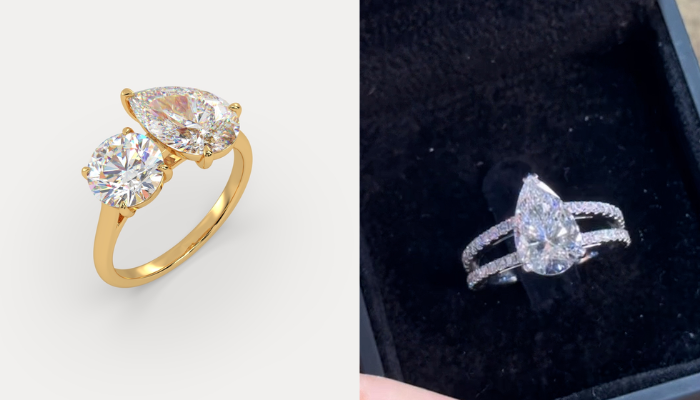
With 3D rendering, brands can generate unlimited product variations instantly.
A single CAD design can produce:
yellow gold version
white gold version
rose gold version
platinum version
without any new photoshoot.
2. Faster Product Launches
Speed is critical in modern e-commerce.
Rendering allows jewelry companies to launch products before manufacturing begins.
Marketing teams can create:
website product pages
digital catalogs
online advertisements
using rendered images.
This accelerates time-to-market dramatically.
3. Perfect Visual Consistency
Traditional photography often suffers from inconsistencies:
lighting variations
shadow differences
color shifts
3D rendering ensures perfect visual consistency across all product images.
Every piece of jewelry appears under identical lighting conditions.
This creates a premium, luxury-brand aesthetic.
4. Better Customization Experiences
Customization is one of the biggest trends in jewelry e-commerce.
Consumers increasingly want to:
design engagement rings
select gemstones
Choose metal colors
personalize jewelry
3D rendering powers interactive ring builders and configurators that allow customers to visualize their custom jewelry in real time.
This dramatically improves customer engagement.
5. Higher Conversion Rates
High-quality product visuals directly influence purchasing decisions.
Studies in e-commerce show that better product visualization can increase conversions by 20–40%.
3D rendering enables brands to create:
360-degree product views
zoom-level gemstone details
realistic reflections and sparkle
These features help customers feel confident purchasing jewelry online.
The Technology Behind Photorealistic Jewelry Rendering
The realism of modern rendering comes from sophisticated technologies.
Physically Based Rendering (PBR)
PBR simulates real-world light interactions with surfaces.
This allows metals and gemstones to behave exactly as they would under physical lighting.
Ray Tracing
Ray tracing calculates the path of light rays as they bounce off surfaces.
For diamonds, this process simulates:
light dispersion
sparkle
internal reflections
This is essential for achieving realistic gemstone visuals.
HDRI Lighting
High Dynamic Range Imaging (HDRI) environments replicate studio lighting setups.
This ensures accurate reflections in polished metals such as gold and platinum.
The Role of Rendering in Jewelry E-commerce
The growth of online jewelry sales has accelerated the demand for high-quality digital visuals.
Modern jewelry e-commerce websites rely on rendering for:
product images
social media campaigns
online advertisements
digital catalogs
product configurators
Rendering also enables brands to maintain consistent visual identity across all digital channels.
The Rise of Digital Jewelry Marketing
Marketing teams increasingly prefer rendering over photography because it enables faster campaign production.
For example, a single rendered product can easily be adapted into:
Instagram posts
website banners
promotional graphics
email campaigns
This flexibility makes rendering an extremely powerful marketing asset.
Future Trends in Jewelry Visualization
The next decade will likely see even more advanced digital visualization technologies.
Real-Time 3D Product Configurators
Customers will be able to design jewelry interactively within websites.
Augmented Reality Jewelry Try-On
Consumers will preview jewelry on their hands or neck using smartphone cameras.
AI-Driven Jewelry Design
Artificial intelligence may assist in generating new jewelry designs automatically.
Virtual Jewelry Showrooms
Brands may eventually display collections inside immersive digital environments.
These innovations all rely heavily on high-quality 3D rendering.
The New Standard for Jewelry Visualization
The jewelry industry is undergoing a digital transformation.
As e-commerce continues to dominate retail, the need for scalable, high-quality product visuals has never been greater.
3D jewelry rendering offers:
Lower production costs
Faster product launches
Unlimited design variations
Better customer engagement
Higher online conversions
For jewelry brands looking to compete in the digital marketplace, adopting advanced rendering technology is no longer optional.
It is becoming the new industry standard.