+32 460 23 96 44

On this page
- From Craftsmanship to Computational Design
- The Traditional Jewelry Design and Rendering Workflow: Bottlenecks and Constraints
- 1. Concept Development
- 2. CAD Modeling
- 3. Rendering
- 4. Prototyping
- 5. Client Approval
- Key Bottlenecks in the Traditional Model
- Where AI Integrates into the Jewelry Pipeline
- AI Integration Points:
- AI in Jewelry Design: Moving Beyond Generative Aesthetics
- 1. Parametric Design Optimization
- 2. Style Learning and Pattern Recognition
- 3. Rapid Design Iteration
- AI in Jewelry Rendering: The Core of Scalable Visualization
- 1. Photorealistic Rendering at Scale
- 2. Material Intelligence and Precision
- 3. Batch Rendering for Large Catalogs
- 4. Faster Client Approval Cycles
- ROI Analysis: Measuring the Business Impact of AI Adoption
- 1. Time Efficiency
- 2. Cost Reduction
- 3. Increased Throughput
- 4. Improved Conversion Rates
- Customization at Scale: A Competitive Advantage in the Luxury Segment
- Operational Transformation: Redefining Team Roles
- Designers
- CAD Teams
- Rendering Teams
- Challenges and Strategic Considerations
- 1. Data Dependency
- 2. Risk of Design Homogenization
- 3. Integration Complexity
- 4. Intellectual Property Concerns
- The Future: AI as a Collaborative Partner, Not a Replacement
- Strategic Conclusion: AI as a Competitive Imperative
From Craftsmanship to Computational Design
The jewelry industry has long been defined by craftsmanship, precision, and artistic intuition. For decades, the workflow—from hand sketches to CAD modeling and final rendering—has remained largely linear, time-intensive, and dependent on highly specialized human expertise.
However, this paradigm is undergoing a fundamental transformation.
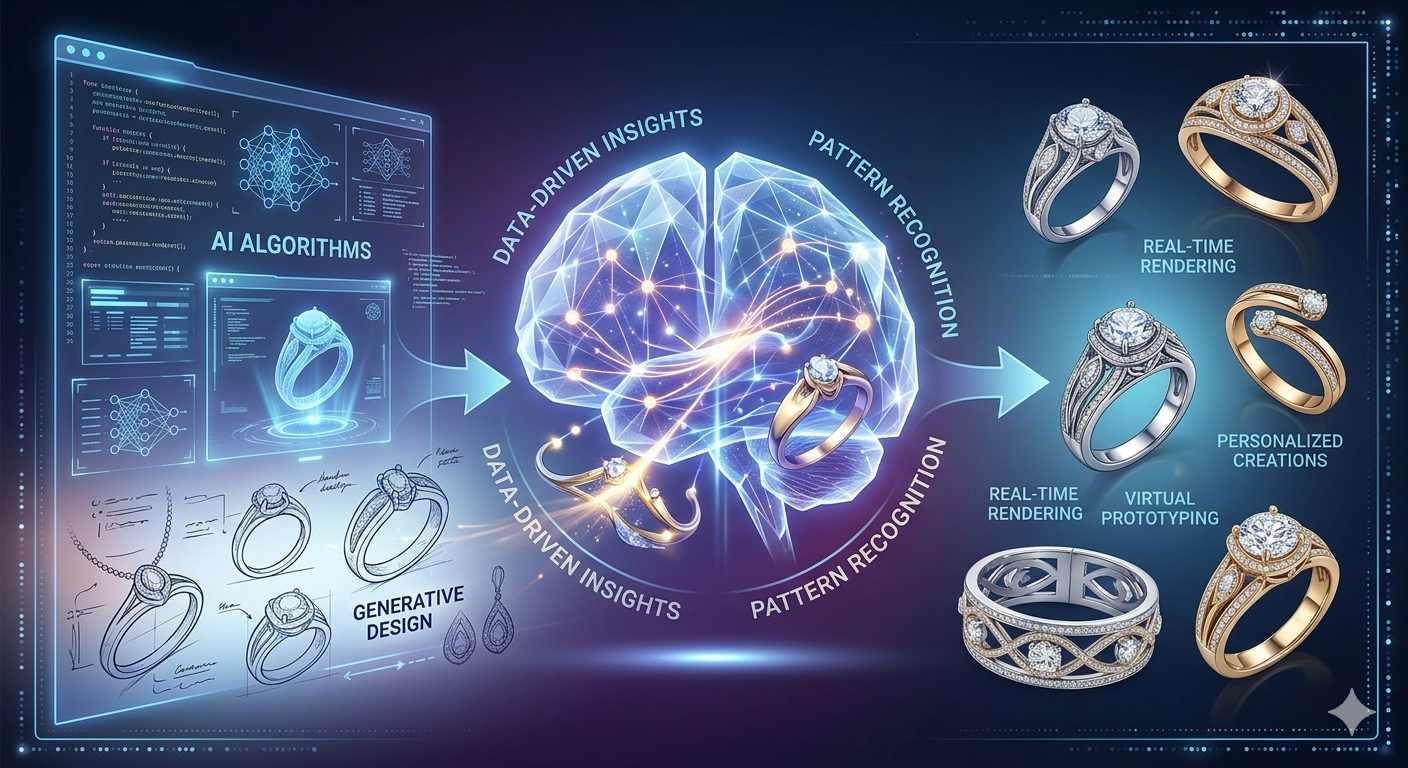
Artificial Intelligence (AI) is no longer a futuristic concept in jewelry design; it is rapidly becoming a core operational layer across design, visualization, and production pipelines. What began as incremental improvements in CAD tools has now evolved into AI-driven design generation, intelligent rendering, and scalable visualization systems.
For B2B stakeholders—manufacturers, exporters, and large-scale retailers—the implications are significant:
Reduced time-to-market
Scalable design production
Faster client approvals
Lower operational costs
AI is not simply enhancing creativity; it is redefining how jewelry businesses operate, compete, and scale.
The Traditional Jewelry Design and Rendering Workflow: Bottlenecks and Constraints
Before understanding the impact of AI, it is essential to analyze the traditional workflow:
1. Concept Development
Designers create initial sketches based on trends, client briefs, or internal collections.
2. CAD Modeling
The sketch is translated into a 3D CAD model using software like Rhino or Matrix.
3. Rendering
High-quality renders are generated to visualize the final product using rendering engines.
4. Prototyping
Physical prototypes are created for validation.
5. Client Approval
Designs are reviewed, revised, and finalized.
Key Bottlenecks in the Traditional Model
Iteration Delays: Each design revision requires manual rework
Rendering Constraints: High-quality rendering is time-consuming
Cost of Prototyping: Physical samples increase cost and lead time
Limited Scalability: Expanding product catalogs requires proportional team expansion
This model, while effective, is increasingly misaligned with modern market demands—especially in a landscape driven by rapid trend cycles and customization.
Where AI Integrates into the Jewelry Pipeline
AI does not replace the existing workflow—it augments and optimizes it at multiple stages.
AI Integration Points:
This layered integration allows businesses to compress timelines while increasing output quality and volume.
AI in Jewelry Design: Moving Beyond Generative Aesthetics
While AI-generated design is often associated with automated visuals, its real value lies deeper—in data-driven design intelligence.
1. Parametric Design Optimization
AI can analyze design parameters such as:
Stone placement
Weight distribution
Structural integrity
This enables designs that are not only aesthetically appealing but also manufacturing-efficient.
2. Style Learning and Pattern Recognition
AI systems trained on historical design datasets can:
Identify successful design patterns
Generate variations aligned with brand identity
Predict which styles may perform well in the market
This transforms design from intuition-driven to data-informed decision-making.
3. Rapid Design Iteration
Instead of manually creating multiple versions, AI can generate:
Dozens of design variations
Minor modifications instantly
Customizations based on client input
This significantly reduces design iteration latency, a critical factor in B2B environments.
AI in Jewelry Rendering: The Core of Scalable Visualization
For companies like jewelexperts.com, rendering is not just a visual step—it is a business-critical function.
AI is fundamentally transforming how jewelry rendering is executed.
1. Photorealistic Rendering at Scale
Traditional rendering requires:
Manual lighting setup
Material configuration
Long processing times
AI-driven rendering engines can:
Automatically simulate lighting conditions
Accurately replicate materials like gold, platinum, and diamonds
Generate near-instant photorealistic images
This allows businesses to produce high-quality visuals without proportional increases in effort.
2. Material Intelligence and Precision
Jewelry rendering is uniquely complex due to:
Reflective metals
Transparent gemstones
Light refraction
AI models are now capable of:
Simulating gemstone brilliance
Replicating metal finishes with high accuracy
Adjusting reflections dynamically
This level of precision is essential for client trust and purchase decisions, especially in remote B2B transactions.
3. Batch Rendering for Large Catalogs
For large jewelry businesses managing thousands of SKUs:
AI enables automated batch rendering
Consistent quality across all designs
Rapid catalog generation
This transforms rendering from a bottleneck into a scalable production system.
4. Faster Client Approval Cycles
With AI-powered rendering:
Clients can view realistic designs instantly
Revisions can be visualized in real-time
Decision-making cycles are significantly shortened
This directly impacts sales velocity and operational efficiency.
ROI Analysis: Measuring the Business Impact of AI Adoption
For B2B decision-makers, the adoption of AI must be justified through tangible returns.
1. Time Efficiency
Design iteration time reduced by 40–70%
Rendering time reduced from hours to minutes
2. Cost Reduction
Lower dependency on manual labor
Reduced need for physical prototypes
Optimized resource allocation
3. Increased Throughput
Ability to handle larger design volumes
Faster product launches
Improved responsiveness to market trends
4. Improved Conversion Rates
High-quality renders improve client confidence
Faster approvals lead to quicker deal closures
Customization at Scale: A Competitive Advantage in the Luxury Segment
Modern consumers demand personalization—even in high-end jewelry.
AI enables:
Mass customization without operational complexity
Real-time design adjustments
Client-specific variations
For B2B businesses, this means offering bespoke experiences at scale, a key differentiator in competitive markets.
Operational Transformation: Redefining Team Roles
AI adoption does not eliminate roles—it redefines them.
Designers
Shift from manual creation to creative direction and validation
CAD Teams
Focus on refining AI-generated models
Rendering Teams
Manage and optimize AI rendering pipelines
This results in a more efficient, high-output organizational structure.
Challenges and Strategic Considerations
Despite its advantages, AI adoption comes with challenges:
1. Data Dependency
AI systems require high-quality datasets to perform effectively.
2. Risk of Design Homogenization
Over-reliance on AI may lead to repetitive design patterns.
3. Integration Complexity
Adopting AI into existing workflows requires:
Technical expertise
Process restructuring
4. Intellectual Property Concerns
Ownership of AI-generated designs can be a grey area.
The Future: AI as a Collaborative Partner, Not a Replacement
The future of jewelry design is not AI vs humans—it is AI + human collaboration.
Emerging trends include:
AI-assisted design platforms
Real-time AR/VR jewelry visualization
Fully digital product development pipelines
Businesses that adopt AI early will benefit from:
Faster innovation cycles
Stronger market positioning
Higher operational efficiency
Strategic Conclusion: AI as a Competitive Imperative
AI is no longer an optional enhancement in jewelry design and rendering—it is a strategic necessity.
For B2B jewelry businesses, the advantages are clear:
Accelerated workflows
Scalable design and rendering capabilities
Improved client engagement
Stronger competitive positioning
In an industry where precision, speed, and visual excellence define success, AI provides a decisive edge.
Organizations that integrate AI into their design and rendering pipelines today will not only optimize operations but also redefine their growth trajectory in the years ahead.Interesting Reads
Amazing Benefits of 3D Rendering in Jewelry Marketing
What Is the Best Jewelry CAD Software?
Customizing Jewelry with 3D Technology
How Virtual Try Ons can Help You Close More Sales for Your Jewelry Business
Top Benefits of Live Chat for Your Jewelry Website
Why Jewelry Brands Should Use 3D Renders for Social Media Marketing