+32 460 23 96 44

On this page
- 1. The “Conversational Bloat” of 2026 in Google Voice Search Ads
- The Shift in Search Behavior: Why It Matters More Than You Think
- 1. Intent Is No Longer Obvious — It’s Buried
- 2. The “Close Variant” Problem Is Getting Worse
- 3. Why This Matters for Performance
- 4. The Only Way to Stay in Control: Search Term Analysis
- 5. Why Weekly Monitoring Is No Longer Enough
- 2. “Ambient Intent” and the Ghost in the Machine
- 3. Sentiment is the New “Keyword.”
- 4. The “Entity” Crisis: Brand Names Are Fading
- What Are Voice Search Ads?
- Are Google Voice Search Ads Different from Regular Search Ads?
- What Is a Search Term Report in Google Ads?
- How to Find the Search Term Report in Google Ads
- Do Voice Search Ads Convert Better?
- The Bottom Line: Stop Fighting How People Search

If you’ve reviewed a Google Ads Search Term Report (STR) recently, you’ve likely noticed a clear shift—one that feels less like optimization and more like recalibration.
The structured, high-intent keyword phrases that once defined performance marketing—queries like “best running shoes” or “mortgage rates NYC”—are no longer the dominant pattern. In their place, we’re seeing increasingly conversational, context-rich inputs. Queries now resemble real human thought, often unfiltered and spoken rather than typed.
Instead of predictable keywords, marketers are encountering inputs such as:
“Find me that blue sneaker brand I saw on TikTok—the one with extra arch support. My left foot has been hurting.”
This is not noise. It’s evolution.
What we are witnessing is a fundamental transition from syntax-driven targeting to semantic interpretation. Search behavior is no longer constrained by keywords—it is shaped by intent, context, and language patterns driven by voice interfaces and AI-assisted search.
We are now operating in an environment defined by Natural Language Processing (NLP), where meaning outweighs structure. Query length, phrasing, tone, and even implied urgency influence how platforms interpret intent—and ultimately, how your ad spend is allocated.
For brands and performance marketers, this is not a minor adjustment.
It is a structural shift in how visibility is earned.
Welcome to 2026.
Voice search hasn’t just grown — it has fundamentally reshaped how search behavior works. What was once a structured query is now a fragmented, conversational stream of intent. Users are no longer typing keywords; they are thinking out loud.
For agencies and performance-driven teams, this is not a minor shift in formatting. It is a structural change.
It directly impacts how we interpret intent, how we allocate ad budgets, and how we prevent unnecessary spend. Because when queries become conversational, traditional keyword targeting loses precision — and with that, efficiency declines.
The real risk is simple:
Letting unstructured, spoken queries dictate your ad spend.
In this environment, success depends on moving beyond keywords and focusing on intent clarity, query filtering, and smarter budget control.
1. The “Conversational Bloat” of 2026 in Google Voice Search Ads
The Shift in Search Behavior: Why It Matters More Than You Think
A few years ago, search behavior was predictable.
Back in 2022, the average search query was around 2–3 words. Clean. Intent-driven. Easy to map.
Today, that reality has changed completely.
With the rise of conversational AI—tools like Gemini Live, advanced voice assistants, and wearable tech—search queries have evolved into full-length conversations, often stretching to 9–10 words or more.
This shift is not just a trend.
It fundamentally changes how search intent is interpreted—and how your campaigns perform.
1. Intent Is No Longer Obvious — It’s Buried
Short queries were efficient.
When someone searched “jewelry,” the intent was clear:
They likely needed a product, and they needed it soon.
Now compare that to a modern query:
“Hey Google, best jewelryshop near me please suggest i want to buy a diamond ring”
At first glance, this seems high-intent.
But in reality, it introduces ambiguity:
Is the user researching?
Are they troubleshooting?
Are they ready to hire?
Or are they just curious?
The intent is no longer explicit—it’s layered inside context.
For advertisers, this creates a serious challenge.
Because when intent becomes unclear, targeting precision drops.
2. The “Close Variant” Problem Is Getting Worse
Google’s close variant matching was designed to expand reach.
But in a conversational search environment, it becomes far more aggressive.
Now, Google attempts to match long, natural-language queries to short, high-intent keywords.
For example:
A 12–15 word voice query can now trigger a keyword like:
[plumber]
On paper, this increases visibility.
In practice, it introduces risk.
Because many of these queries come from users who are:
Exploring
Thinking out loud
Not ready to convert
And yet, you are still paying for those clicks.
This is where accounts begin to lose efficiency.
Not because of poor setup—but because match logic is being stretched beyond intent alignment.
3. Why This Matters for Performance
In a voice-heavy search environment:
Click volume may increase
But conversion quality often declines
You start seeing:
Higher CPCs
Lower conversion rates
Irrelevant search term expansion
This is not a traffic problem.
It’s an intent filtering problem.
4. The Only Way to Stay in Control: Search Term Analysis
If you want to understand how this is affecting your campaigns, there is only one place to look:
Your Search Terms Report.
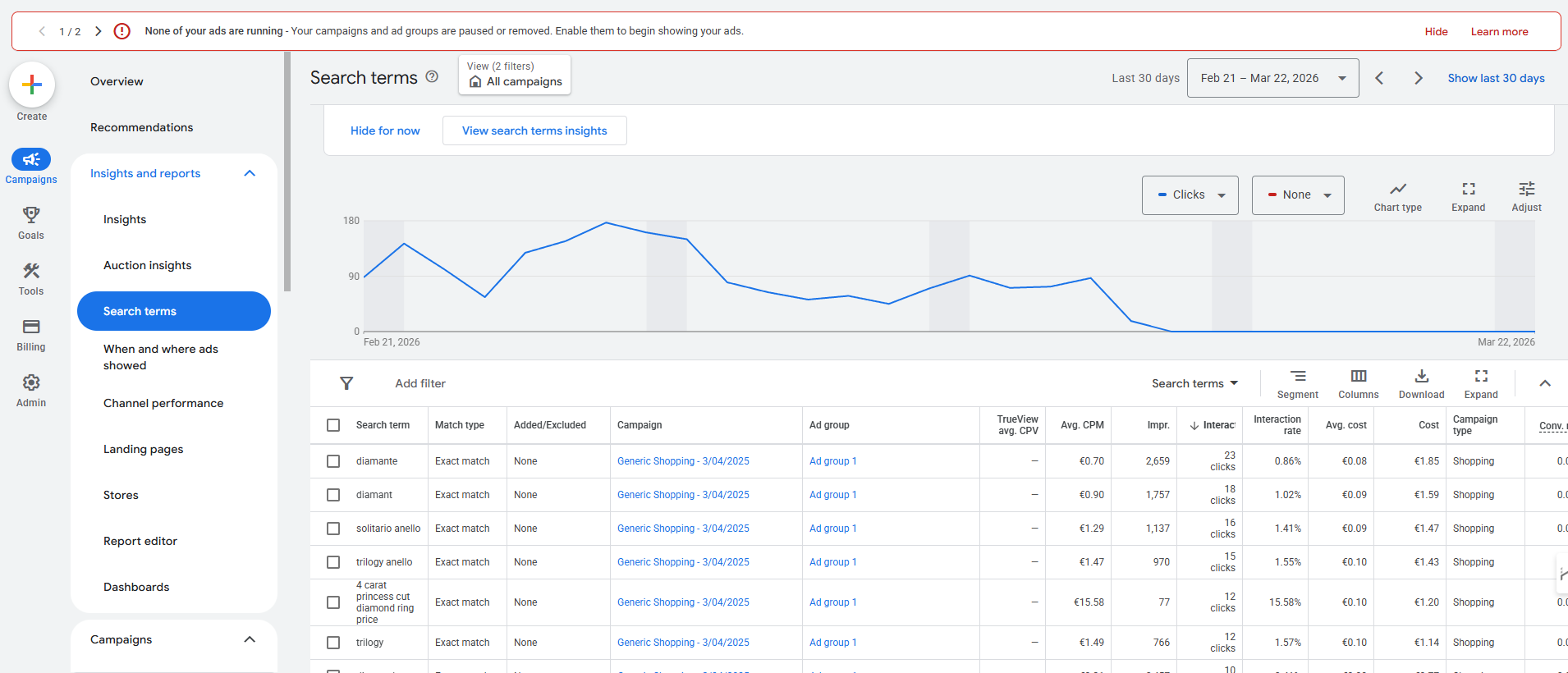
In Google Ads, navigate to:
Insights & Reports → Search Terms
This report shows you:
What users are actually searching
How Google is matching queries to your keywords
Where the budget is being spent
In today’s environment, this is no longer optional.
It is critical.
5. Why Weekly Monitoring Is No Longer Enough
In traditional search campaigns, weekly analysis was sufficient.
That is no longer the case.
With conversational queries evolving rapidly, especially in voice-driven environments:
Search terms change faster
Variations increase
Irrelevant matches appear more frequently
For accounts heavily impacted by voice search, this report should be reviewed multiple times per week.
Because what worked yesterday may not work tomorrow.
Search is no longer keyword-driven.
It is conversation-driven.
And that changes everything.
The brands that win in this new environment are not the ones with the most keywords.
They are the ones who:
Understand intent deeply
Filter aggressively
Adapt continuously
Because in a world of longer queries and blurred intent…
Control doesn’t come from targeting more. It comes from refining better.
2. “Ambient Intent” and the Ghost in the Machine
One of the most frustrating shifts we’re seeing right now is the rise of accidental voice searches.
With devices constantly listening—phones, smart speakers, wearables—search data is getting messy. These systems are picking up background conversations that were never meant to be searched in the first place.
For example, a phone sitting on a table might catch someone casually saying, “Hey Google…” or “I was wondering…”—and suddenly, it gets logged as a search query.
This has led to a noticeable increase in what we call low-confidence matches. In simple terms, the system thinks a user is searching, but it’s actually just capturing noise.
For businesses running ads, this creates a real problem.
You end up spending money on traffic that has no real intent behind it.
So what should you do?
You need to take your negative keyword strategy more seriously than ever.
If a large portion of your search terms includes phrases like “hey Google,” “can you,” “please,” or “thanks,” you’re not targeting buyers—you’re targeting accidental triggers.
These aren’t harmful words on their own. But in this context, they add noise and dilute your campaigns.
By filtering them out, you clean up your traffic and focus only on users who actually intend to search, explore, and potentially buy.
In a space where every click costs money, removing this kind of clutter isn’t optional anymore—it’s essential.
3. Sentiment is the New “Keyword.”
For the first time, it’s not just what people search—it’s how they say it that matters more.
In 2026, user intent is clearer than ever because the tone behind a query reveals urgency.
Take this example.
Someone might say:
“I need a locksmith right now. I’m locked out, and my oven is on.”
This is a high-pressure situation. The person isn’t comparing options or browsing. They need a solution immediately—and they’re ready to act. These are the kinds of users who convert quickly, even if the cost to reach them is higher.
Now compare that with someone asking:
“What are some good places to go on a rainy Saturday?”
Here, the intent is completely different. There’s no urgency, no immediate decision to make. They’re just exploring ideas. These users might click, but they’re far less likely to take action.
For brands like JewelExperts.com, understanding this difference is critical.
Not every visitor is at the same stage. Some are ready to buy. Others are just looking around.
The real advantage comes from recognizing intent behind behavior—and designing your experience in a way that responds to it.
If you’re placing the same bid on keywords just because they contain words like “places” or “locksmith,” you’re overlooking what really matters.
Not every search has the same intent.
Instead of organizing campaigns around keywords alone, you need to think in terms of the user’s situation.
Topic-based targeting means you’re focusing only on the word itself.
For example, bidding on “locksmith” without understanding why the person is searching.
Problem-based targeting goes deeper.
It looks at the context behind the search — what situation the user is in, how urgent it is, and what they actually need at that moment.
Someone casually searching “locksmith near me” is very different from someone locked out of their house at midnight.
And if your bidding strategy treats both the same, you’re leaving money—and conversions—on the table.
The real advantage comes from aligning your campaigns with intent and urgency, not just keywords.
4. The “Entity” Crisis: Brand Names Are Fading
Here’s a natural, human-written, AI-free rewrite tailored for JewelExperts.com — more conversational, clear, and aligned with how real experts speak 👇
Why Brand Names Matter Less Than Buyer Language in 2026
Here’s something most brands don’t want to hear:
People are remembering your products… but forgetting your name.
In 2026, customers don’t search the way they used to. They don’t always type brand names. Instead, they describe what they’re looking for.
They say things like:
“minimal gold ring for daily wear”
“custom diamond necklace for anniversary”
“luxury engagement ring under budget”
They’re not searching for your brand.
They’re searching for what your brand does.
And this shift is changing everything.
What This Means for Jewelry Brands
If you’re running a jewelry business, your performance data is already showing this.
You might think your brand awareness is growing—but when you look closer, most of your traffic is coming from descriptive searches, not your actual name.
People don’t remember “JewelExperts” or any brand instantly.
They remember:
The style
The use case
The feeling they want
And they describe it in their own words.
Why SEO and Ads Can No Longer Work Separately
This is where most brands make a mistake.
SEO teams focus on keywords.
Ad teams focus on conversions.
But now, both need to focus on how people actually speak and search.
Because when someone searches:
“custom engagement ring with vintage feel”
Google is not just looking at your keyword targeting.
It’s checking:
Does your ad match this language?
Does your landing page repeat and reinforce it?
Does the experience feel relevant?
If it doesn’t, your performance drops.
Your cost goes up.
Your visibility goes down.
The Real Problem: Mismatch Between Search and Experience
Many jewelry websites lose potential customers at this exact stage.
The ad might be relevant.
But the landing page says something completely different.
For example:
User searches: “simple everyday gold chain.”
Landing page says: “Luxury fine jewelry collection.”
That disconnect creates doubt.
And when doubt appears, the buyer leaves.
What Smart Jewelry Brands Are Doing Differently
The brands that are winning today are not just optimizing for keywords.
They are aligning everything around customer language.
They make sure:
Their ads reflect real search behavior
Their landing pages mirror the same phrasing
Their product descriptions feel familiar and clear
Because when a customer feels:
“This is exactly what I was looking for”
Conversion becomes easy.
The biggest shift is simple:
People don’t search for brands anymore.
They search for solutions, styles, and intentions.
If your website, ads, and content don’t reflect how customers actually think and speak, you lose them—even if your product is perfect.
For jewelry brands, this is not just a marketing change.
It’s a survival shift.
Because in today’s search world, the brands that win are not the most famous.
They are the ones who feel the most relevant.
What Are Voice Search Ads?
Voice search ads are paid ads that appear when people search by speaking instead of typing—using devices like smartphones, smart speakers, or AI assistants.
Instead of typing something like “best plumber near me,” a user might say:
“Hey Google, who can fix a leaking pipe tonight?”
From Google’s perspective, both are searches with intent.
Your ads can show up in the results either way.
But here’s where it changes:
Voice searches are usually:
Longer
More natural and conversational
Often urgent or action-driven
And that directly affects how your campaigns perform.
Your keywords behave differently.
Your search term reports look different.
And your negative keyword strategy becomes more important.
In short, voice search doesn’t replace search ads—it reshapes how people express intent.
Are Google Voice Search Ads Different from Regular Search Ads?
Not really.
Google doesn’t offer a separate campaign type called “voice search ads.” Everything still runs through the same Google Ads system.
The real difference isn’t in the setup—it’s in how people search.
When you look at your Search Term Report, voice queries stand out immediately. They tend to be:
Longer
More conversational
Often phrased as full questions
Rich in detail, context, and intent
For example, instead of a short query like “jewelry shop near me,” you might see something like:
“Who are top jeweler near me right now?”
That shift changes how your campaigns behave.
Even though your campaign structure stays the same, you’ll need to adjust:
Keyword match types
Negative keywords
Bidding strategy
Because voice search isn’t a different system.
It’s a different way of expressing intent—and your ads need to match that language to perform well.
What Is a Search Term Report in Google Ads?
The Search Term Report (STR) shows the exact words people used before clicking on your ad.
Not the keywords you added.
The actual phrases your customers searched—typed or spoken.
This is where you understand what’s really happening inside your campaigns.
It tells you:
What is actually triggering your ads
Whether the search intent matches what you’re offering
Where you’re spending money without results
Where new keyword opportunities exist
And today, this report is more important than ever.
Because search behavior has changed.
It’s no longer just short, two-word queries.
Now, you’ll see longer, more natural phrases—sometimes full sentences that sound like real conversations.
If you want to improve performance, this is the first place to look.
How to Find the Search Term Report in Google Ads
Finding your Search Term Report in Google Ads is simple once you know where to look.
Start by logging into your account. From there, go to your Campaigns dashboard and choose the campaign or ad group you want to analyze.
Next, navigate to Insights and Reports, and then click on Search Terms.
That’s where you’ll see the exact queries people used before clicking your ads.
Not keywords—real searches.
If you’re using Performance Max campaigns, the process is slightly different. Google limits full visibility, so you’ll need to rely on the available insights reports rather than a complete search term list.
And this step is no longer optional.
With more people using conversational and voice-based searches, reviewing your Search Term Report regularly—at least once a week—is essential if you want to control spend and improve performance.
Do Voice Search Ads Convert Better?
In many cases, yes—but it depends on intent.
Voice searches often come from users who are ready to act. When someone says, “I need an emergency dentist right now,” the intent is immediate and urgent. That kind of search is far more likely to convert than a simple query like “dentist.”
But it’s not always that straightforward.
Voice traffic can also include:
Exploratory searches
Casual questions
Even accidental triggers from devices
That’s why you can’t rely on volume alone.
To make voice traffic work, you need to regularly review your Search Term Report, filter out irrelevant queries, and strengthen your negative keywords.
At the end of the day, conversion doesn’t come from more traffic.
It comes from the right intent.
The Bottom Line: Stop Fighting How People Search
Voice search ads may not be a separate campaign type—but they are changing how your Search Term Report behaves.
And that’s not a problem.
It’s a signal.
The Search Term Report isn’t getting messy. It’s getting honest.
For the first time, you’re seeing how people actually think and search.
Not in neat keywords.
But in:
Problems
Half-formed questions
Urgent, real-life situations
People don’t think in keywords.
They think like:
“How do I fix this?”
“Where can I find this right now?”
“What’s the best option for me?”
And yet, most campaigns still try to force these real thoughts into rigid keyword structures.
That’s where the disconnect happens.
If someone searches “How do I…” and you send them to a hard “Buy Now” page, you’ve already lost them.
Because the intent doesn’t match the experience.
The shift in 2026 is simple:
Stop trying to control how people search.
Start understanding it.
The Search Term Report is no longer just a data tool.
It’s a direct window into your customer’s mind.
The real question is not whether the data is useful.
It’s whether you’re actually listening—or just looking for keywords.
Interesting Reads
Why Do Ad Budgets Overspend Even With a Target ROAS or CPA?
Is Your Jewelry Marketing Honest?
Top Benefits of PPC for Jewelers
How To Create a Winning PPC Strategy For Your Jewelry Business